

Digital transformation solutions succeed when they change how work gets done—data, workflows, and customer experience—not when they only buy new software logos.
Healthcare prioritizes compliance and scheduling; real estate needs lead routing and listing accuracy; ecommerce cares about conversion and fulfillment visibility; field industries need mobile-ready ops. Teams that treat digital transformation solutions as an operating system—not a one-off project—ship fewer surprises and learn faster from real usage.
Industry patterns inside digital transformation solutions
Sequence work: stabilize data, digitize the highest-friction workflow, integrate systems of record, then layer analytics and automation.
Write assumptions down, assign an owner, and decide what “done” means before tools get purchased. That discipline keeps digital transformation solutions aligned with revenue and service quality instead of slideware.
A roadmap for digital transformation solutions that ship
Train managers as champions, publish a simple success scoreboard, and retire parallel spreadsheets or the old process will silently win.
Use short feedback loops: weekly demos, a visible backlog, and a single scoreboard everyone trusts. If a metric cannot change a decision, drop it.
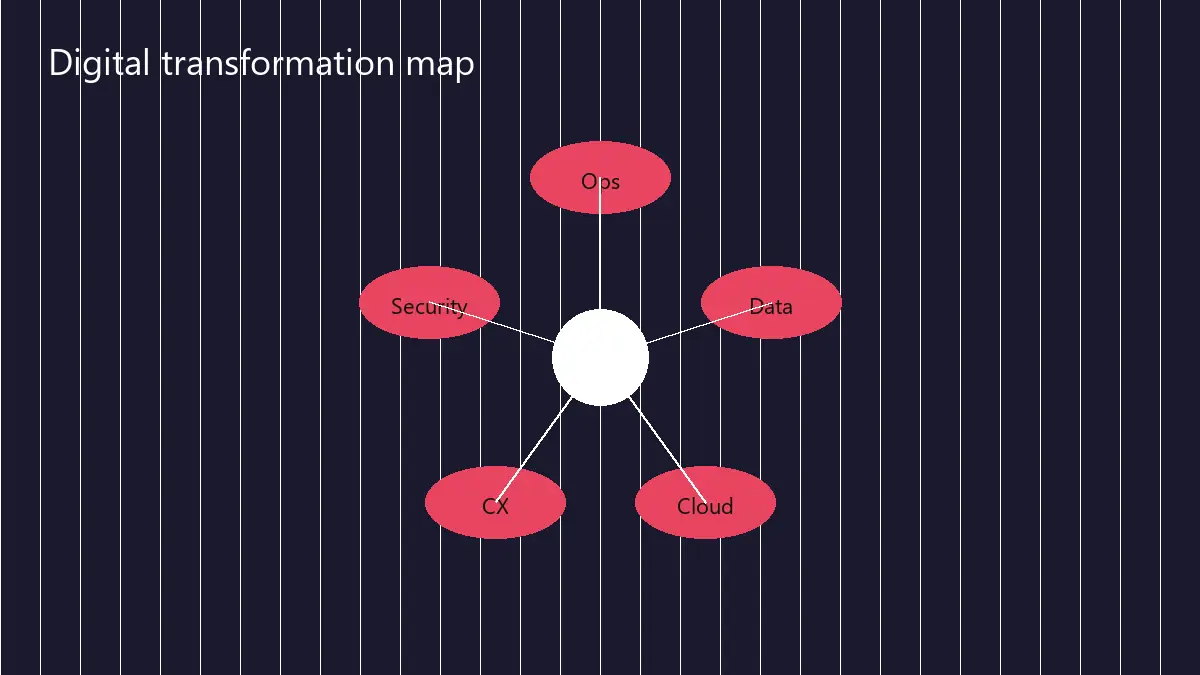
| Layer | Focus | Example |
|---|---|---|
| Ops | Workflow digitization | Approvals + jobs |
| Data | Single source of truth | CRM + ERP sync |
| Cloud | Reliable delivery | Hosted apps |
| CX | Faster journeys | Portals + alerts |
Change management and measurement
Security and access control belong in every phase. Transformation that leaks customer data is not transformation—it is liability.
Publish a lightweight runbook covering owners, access, rollback steps, and review cadence. That is how digital transformation solutions survives holidays, staff changes, and busy seasons.
For reference reading see ISO/IEC 27001 overview. When you need execution support, explore Industries hub · Custom development · contact.
Write the operating metric before you buy tools—otherwise dashboards measure noise.
- Define the painful workflow and success metric
- Ship the smallest useful version
- Measure weekly and prune waste
- Document so the system survives staff changes
- Owner named for each critical workflow
- Baseline metrics captured before changes
- Security and access reviewed with the build
- Customer-facing copy matches what the system can deliver
Portfolio thinking for digital transformation solutions
Fund a small number of value streams instead of twenty disconnected tool pilots. Sequencing beats scatter.
Create cross-functional squads with ops, IT, and a business owner who can decide. Committees without authority stall digital transformation solutions.
Standardize identity and access early. Every new app that invents its own login becomes tomorrow’s audit finding.
Pilot in one region or product line, publish results, then scale. Big-bang cutovers create heroic failures.
Invest in data quality stories staff understand—duplicate customers, missing job statuses—not abstract lake diagrams.
Pair every automation with an exception queue. Transformation without handling edge cases trains people to bypass systems. Durable designs for exceptions.
Celebrate retired spreadsheets publicly. Culture shifts when old workarounds lose status.
Implementation checklist you can run this month
Block ninety minutes on the calendar with the decision maker and the person who does the daily work. Map the current path on a whiteboard, circle the handoffs that fail, and pick one improvement that can ship in two weeks without a committee.
Assign a single owner, write the success metric in one sentence, and schedule a review date before anyone opens a tool catalog. If the metric does not move, change the approach—not the slide deck.
Publish a short internal note after each iteration: what changed, what broke, what customers noticed. That archive becomes training material and keeps digital transformation solutions knowledge from living in one person’s head.
Finally, align your public pages and sales conversations with what the system can truly deliver. Overpromising creates support debt that no marketing channel can fix.
Practical 30-day action plan
Week 1: write the outcome metric, inventory current tools, and list the top three failure points with examples from the last month. Keep the list visible to whoever owns delivery.
Week 2: ship the smallest change that removes one failure point—template fix, automation, script, or process rule. Avoid parallel initiatives that dilute attention.
Week 3: measure results against the baseline, interview two people who use the workflow daily, and document surprises. Adjust scope based on evidence, not preference.
Week 4: package what worked into a checklist, train a backup owner, and schedule the next review. Systems that depend on one hero fail during vacations.
If leadership asks for a bigger transformation mid-sprint, park it on a backlog with a cost note. Momentum comes from finished loops, not larger slide decks.
Share a one-page summary with stakeholders: metric moved, cost in hours, risks remaining, and the next bet. Clear writing protects budgets and trust.
Common mistakes to avoid
Do not buy tools before the workflow is written. Software cannot fix an undefined handoff.
Do not skip training and ownership. Unowned systems return to spreadsheets within a quarter.
Do not optimize vanity metrics. If a chart cannot change a weekly decision, it is decoration.
Do not launch without a rollback path. Fast recovery beats perfect first releases.
Do not hide constraints from stakeholders. Transparent scope builds longer client and leadership relationships than optimistic silence.
Keep a living changelog for stakeholders: what shipped, what is blocked, and what decision is needed next. Written status reduces meeting load and keeps momentum when people work across time zones.
When priorities collide, protect the metric you chose in week one. Adding three new initiatives mid-cycle usually resets learning to zero and trains the team that plans are optional.
Close the loop with a short retrospective: keep, drop, try next. Ten honest minutes beat another hour of status theater.
Frequently asked questions
Where do projects stall?
Unclear owners, dirty data, and scope that tries to reinvent every department at once.
Build or buy platforms?
Buy commodity systems; customize the workflows that create advantage.
How do we show progress?
Pick 3 operating metrics (cycle time, error rate, revenue tasks) and report them monthly.
What about AI?
Add AI after clean workflows and data access exist—otherwise you automate chaos.
Want help applying this in your business?
What good looks like after ninety days
You should see fewer emergency fixes, clearer ownership, and a metric that moved in the right direction at least once. If none of those happened, the plan was theater—reset scope and restart with a smaller loop.
Keep artifacts short: one scoreboard, one backlog, one retrospective note per cycle. Long documents that nobody reads do not count as governance.
Invite a skeptical peer to review the system. Fresh eyes catch brittle steps the builders have normalized.